Turn New Privacy Rules Into Your Competitive Advantage: The EDPB Pseudonymization Breakthrough
What's in a name? How the EDPB's recent guidance on pseudonymization pave the way for better, smarter, faster data sharing.

Thanks for tuning in for this third and final installment in our EDPB pseudonymization series. In Part 1, we explored how landmark European Court rulings like Breyer and Deloitte reshaped the regulatory landscape around data identification. Part 2 examined how the EDPB’s guidance creates new opportunities for privacy-enhancing technologies and cross-border data strategies. Now, we turn to what matters most: transforming these guidelines into competitive advantage.
The Crisis and Opportunity
The European Data Protection Board (EDPB) has just handed every data-driven organization the same challenge: to comply with complex new pseudonymization rules without stifling innovation. Recent breaches, such as the Dutch cervical cancer screening incident (485,000 records exposed)1, highlight a larger truth: traditional data protection approaches are failing organizations just when new EDPB guidelines provide a framework for more effective solutions.
Here’s what forward-thinking organizations understand: this isn’t just another compliance headache. Deploying robust data protection solutions unlocks previously unattainable opportunities for innovation, efficiency, and collaboration. The companies that master the EDPB’s new framework will unlock secure data collaboration, while competitors struggle with compliance paralysis.
The Pseudonymization Domain Revolution
The EDPB guidelines introduce the “pseudonymization domain”3, defined as “the context within which pseudonymisation prevents the attribution of data to specific individuals.”4 Think of domains as logical security zones with different access rules, not technical network domains. Organizations can now architect multiple domains for the same data.
Pseudonymized domains: Recipients can process pseudonymized data but cannot re-identify it, while controllers maintain full GDPR obligations.
Anonymized domains: Recipients lack any means to re-identify individuals and operate under reduced regulatory requirements.
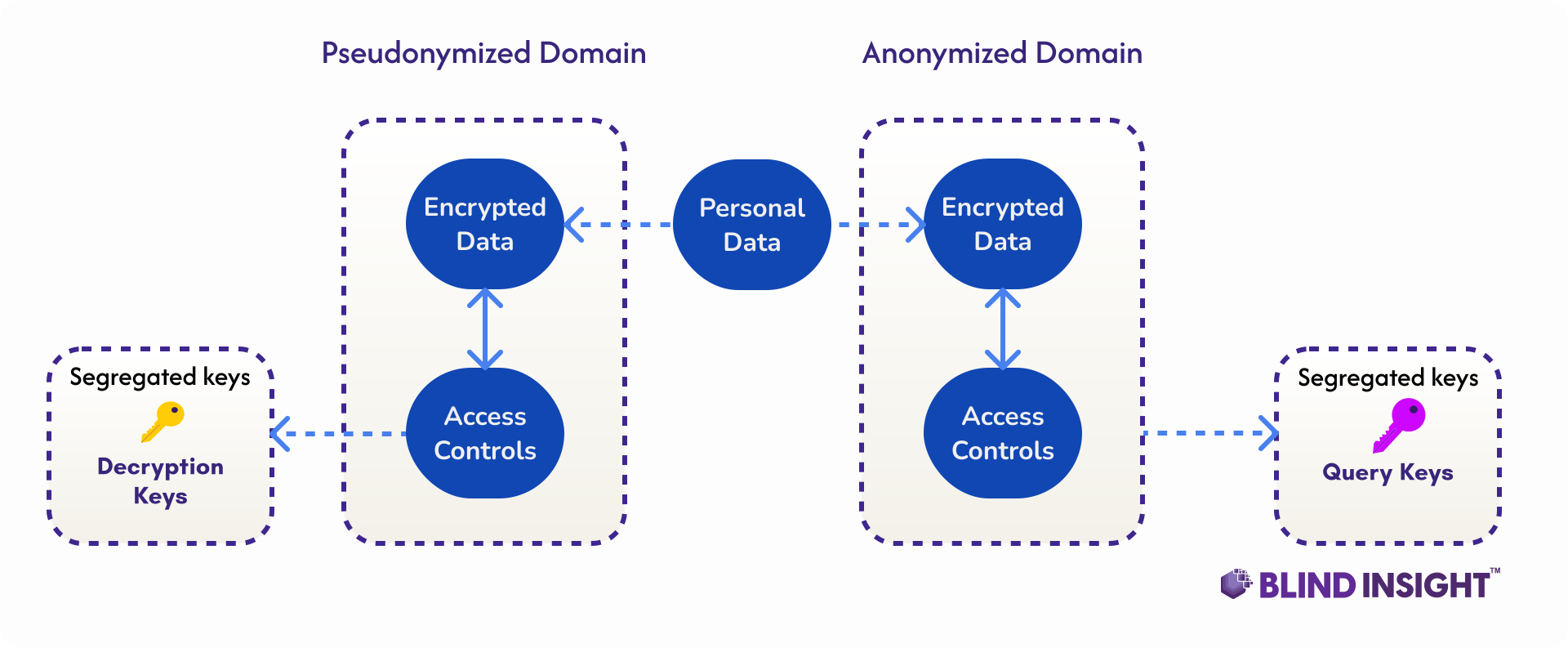
This dual-domain approach means the same customer data can power your internal operations (pseudonymized domain) while enabling completely anonymous analytics for partners (anonymized domain) – without requiring the movement, copying, or re-encryption of a single record. It’s the same data, different legal rules, based purely on who’s accessing it.
The Technical Breakthrough That Changes Everything
The EDPB’s core insight revolutionizes data architecture: the same data can be legally considered “personal” in one domain and “anonymous” in another, depending on who has access and the re-identification capabilities they possess.2 This creates unprecedented opportunities for organizations that can implement domain separations with strong cryptographic guarantees.
At Blind Insight, we’ve focused on solving the analytics catch-22 that has historically limited the practical deployment of privacy-preserving technologies. Unlike legacy solutions that force organizations to choose between data protection and utility, Blind Insight delivers controls that allow you to achieve the ideal balance of both.
While some platforms offer basic encrypted operations, only Blind Insight enables advanced analytics that businesses demand for tasks such as fraud scoring and scientific research – in near real-time, without batch processing or specialized hardware. Match that with our proxy-backed architecture that maintains EDPB-required key segregation while enabling field-level controls, and you’re building a digital Fort Knox – impenetrable from the outside, yet still fully functional for authorized operations.
Real-World Applications: Privacy-First Data in Action
Healthcare Data Sharing
Hospital systems and CROs are actively seeking secure, compliant data sharing infrastructure that meets EHDS (European Health Data Space) and GDPR requirements.
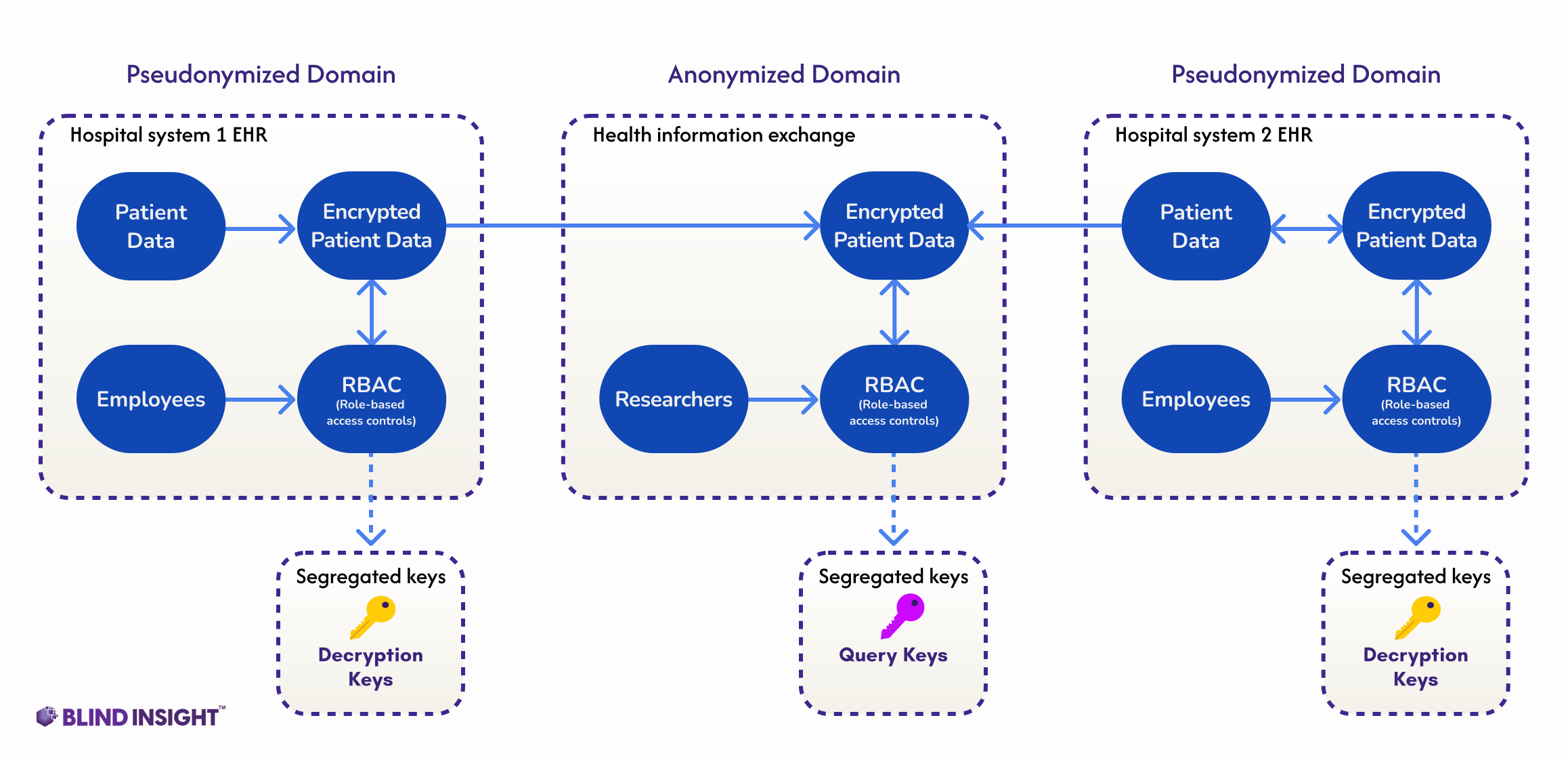
Using Blind Insight, these organizations can operate in a pseudonymized domain, maintaining patient re-identification capabilities for care coordination, while providing an anonymized domain for research partners.
This addresses the core friction point slowing research partnerships: months-long compliance reviews that kill momentum on AI and drug development projects.
Global Fraud Prevention
Financial institutions face a fundamental challenge: fraud operates globally while regulations remain jurisdictional. How do you share enough data between global partners to identify bad actors, without exposing sensitive data or running afoul of GDPR, DORA (Digital Operational Resilience Act), MiCA (Markets in Crypto-Assets Regulation), or the AI Ac
Blind Insight’s answer: Encrypt everything in the country of origin. Keep decryption keys with the data owner. Provide employees with role-based access controls in a pseudonymized domain and partners with query keys to analyze patterns and identify red flags without exposing plaintext in an anonymized domain. This means fraud teams can collaborate across regions within an anonymized domain, while each institution retains control of decryption keys for its own data, allowing them to have full data utility while remaining compliant and secure.
Zero-Trust Customer Service
Customer service centers represent significant opportunities where vast amounts of stored customer data create substantial breach risks. This architecture eliminates the Achilles’ heel: vast databases of sensitive information that become irresistible targets for attackers.
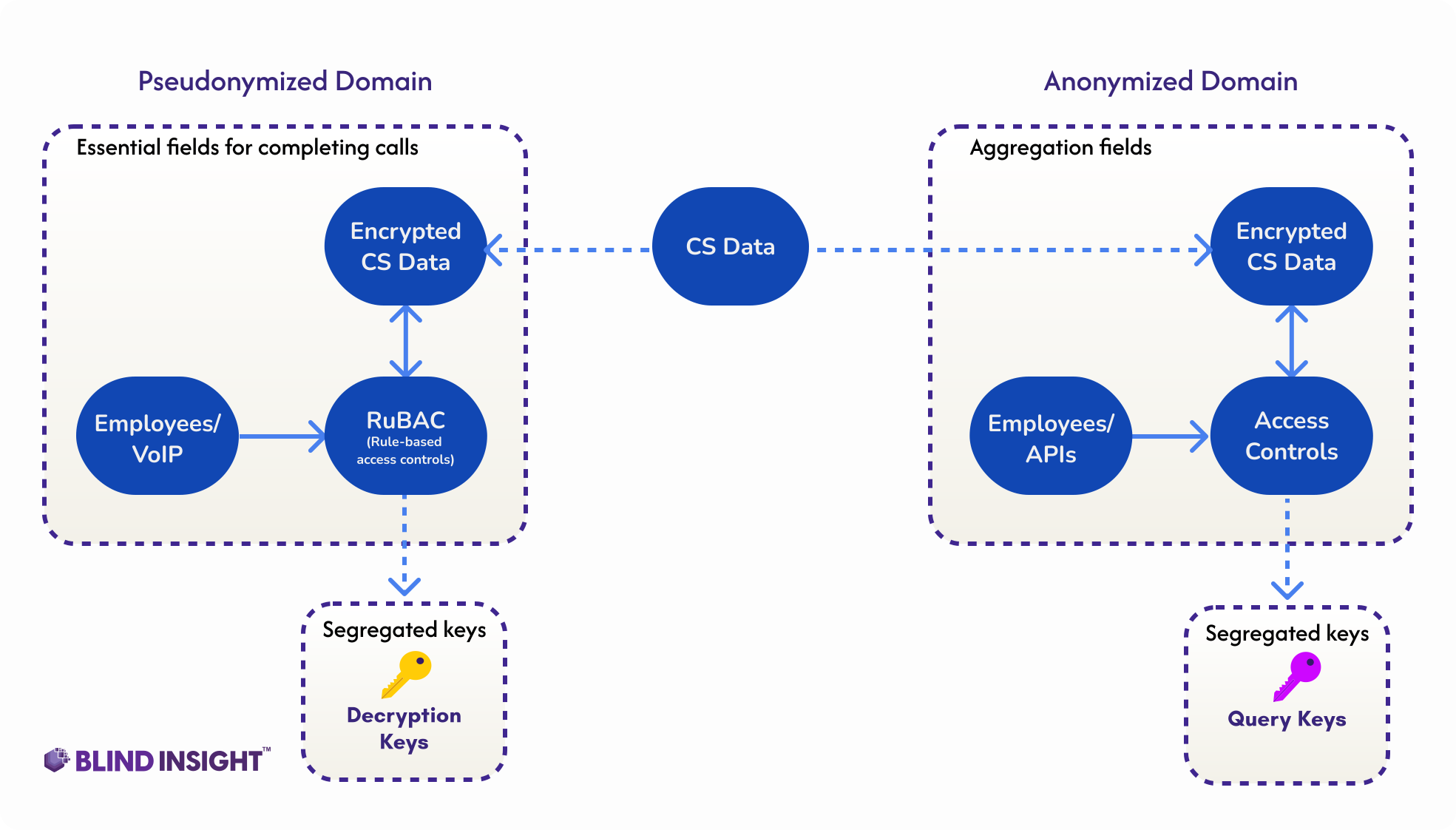
Using Blind Insight’s searchable encryption, employees can generate call lists and receive aggregate insights in an anonymized domain. Active customer calls require a pseudonymized domain where fine-grained access controls enable representatives to decrypt only specific fields necessary to complete calls, and only while calls are in progress. When calls end, keys are revoked, and data returns to its fully encrypted state.
Your EDPB Implementation Roadmap
Ready to put this into practice? Here’s how organizations are approaching EDPB-compliant pseudonymization:
Data Mapping: Identify and classify all personal data flows.
Domain Definition: Explicitly determine who accesses data and identifiers.
Segregated Architecture: Deploy the Blind Proxy™ for cryptographic domain separation.
Advanced Encryption: Implement searchable encryption for analytics without plaintext exposure.
Audit Systems: Establish tamper-proof logging and recurring assessments.
Access Controls: Deploy field-level, context-based permission systems.
Organizations implementing this framework aren’t just avoiding GDPR’s €5.88 billion5 in historical fines; they’re building privacy infrastructure that enables secure collaboration and deeper insights.
Transform Compliance Into Competitive Advantage
Does any of this sound like challenges your organization is facing? We’re here to help. Schedule a 20-minute conversation to explore how the EDPB framework could work for your specific situation.
The EDPB guidelines represent more than just new compliance requirements; they serve as a blueprint for the future of data collaboration. As you consider your organization’s data strategy, think about this: will you be among the leaders who turn these rules into competitive advantages, or will you watch from the sidelines as others capture the value? The choice, and the window of opportunity, is yours.
Ship privacy-preserving search in a week, not a year.
Blind Insight's searchable encryption platform starts at $9/mo. Try it, break it, keep your data encrypted the whole time.
Keep reading
Practical Implications of the New EDPB Pseudonymization Guidelines
Learn how the proposed EDPB guidelines may impact your organization in part two of this three-part series.

Why School Districts Are Racing to Adopt Privacy-Preserving Technologies: A Response to Rising Data Protection Demands
School districts urgently need privacy-preserving tech after a major 2024 data breach. Learn how encryption and zero-trust architectures protect student data, ensure compliance, and rebuild trust in K-12 EdTech.
The Evolution of the EDPB’s Pseudonymization Guidance
Explore the new EDPB pseudonymization guidance and discover how data privacy laws are shaping compliance strategies.